Spain Has One of the World’s Highest Life Expectancies — Here’s Why Expats Are Taking Notice
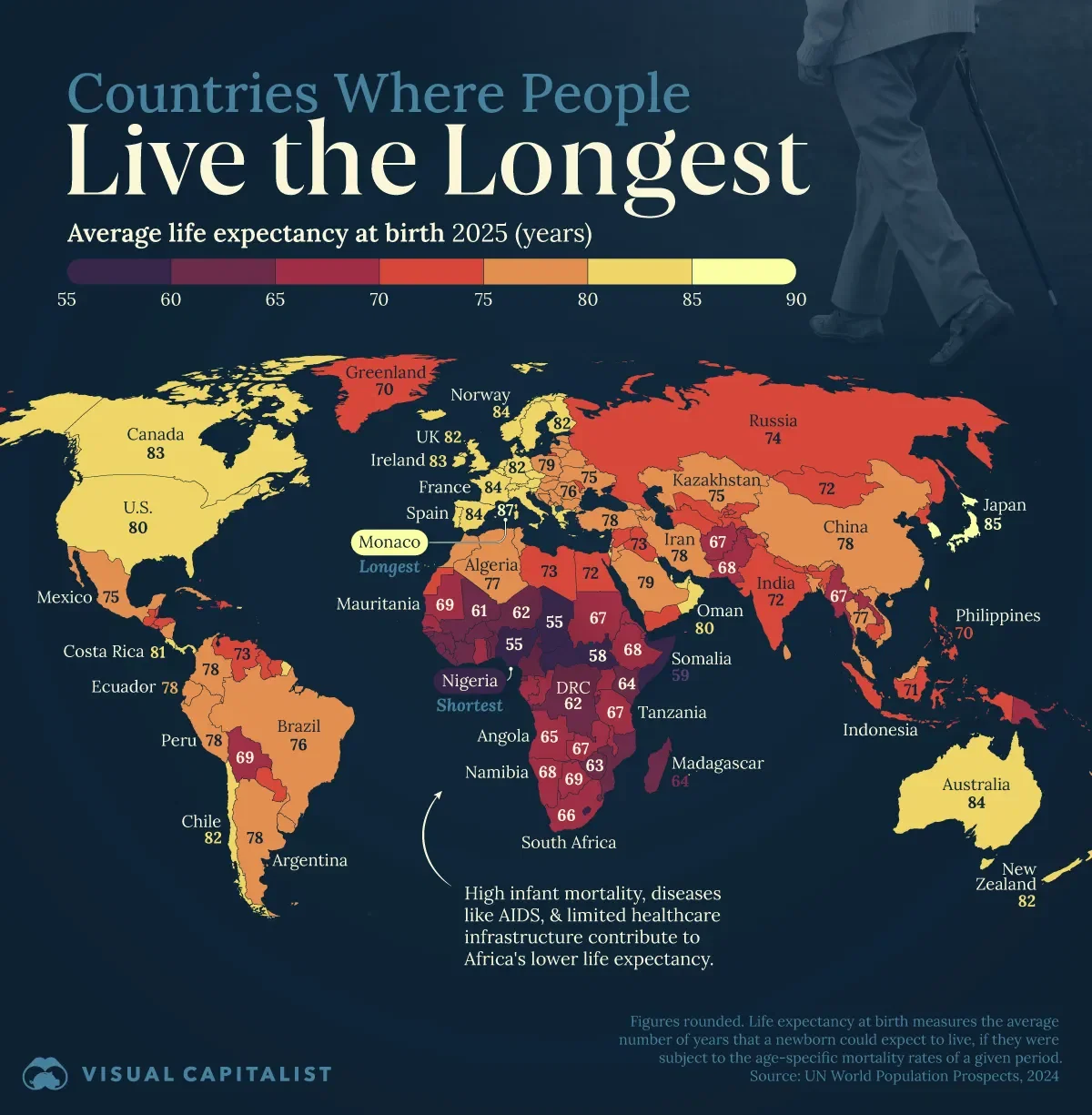
With an average life expectancy of 84 years, Spain ranks second among the world’s 30 largest economies. For foreign buyers considering a move, the numbers tell a compelling story.
Key fact: Spain ranks #2 globally for life expectancy among the world’s 30 largest economies, with an average of 84 years — ahead of France, Germany, the UK, Canada, and the United States. Only Japan (85) surpasses it. Source: UN World Population Prospects 2024, via Visual Capitalist.
When people ask why so many expats choose Spain for their second home, retirement property, or permanent relocation, the conversation usually starts with sunshine, food, and affordability. But there’s a deeper reason — one backed by hard data — that doesn’t get nearly enough attention.
Spain is one of the healthiest countries on the planet. And that matters a great deal when you’re deciding where to spend the next chapter of your life.

The Data: Where Spain Stands Globally
According to the UN World Population Prospects 2024, analysed by Visual Capitalist, Spain records an average life expectancy of 84 years — placing it second among the world’s 30 largest economies, tied with France, Australia, Norway, and Switzerland.
To put that in context, here’s how some key countries compare:
| Country | Life Expectancy (2025) | Economy Rank |
|---|---|---|
| Japan | 85 years | #4 |
| Spain | 84 years 🇹🇫 | #12 |
| France | 84 years | #7 |
| Australia | 84 years | #13 |
| Norway | 84 years | — |
| Canada | 83 years | #9 |
| Ireland | 83 years | — |
| UK | 82 years | #6 |
| New Zealand | 82 years | — |
| United States | 80 years | #1 |
| China | 78 years | #2 |
| Russia | 74 years | #11 |
What makes this especially striking is Spain’s economic position. At #12 globally by GDP, it punches well above its weight — delivering longevity statistics that rival countries with far larger healthcare budgets.
Why Do People Live Longer in Spain?
Researchers and health economists point to a combination of factors that are deeply embedded in Spanish culture and geography — not just healthcare infrastructure.
🌽 The 6 Pillars of Spanish Longevity
What This Means for Foreign Buyers
For expats and second-home buyers, life expectancy data isn’t just an interesting statistic — it’s a practical consideration. If you’re buying a property for retirement, or planning to spend 3–6 months a year in Spain, you’re making a 20–30 year decision about where to live. The quality and length of those years matters.
💡 The expat retirement calculation: A 55-year-old British buyer purchasing in Spain today has a statistical expectation of 27–29 more years of life if they adopt the Spanish lifestyle — vs approximately 27 years remaining in the UK. The difference isn’t just years, it’s quality of life: lower stress, better diet, more sun, and stronger social connection.
Spain also compares extremely favourably on cost of living. Healthcare costs for residents are a fraction of what UK and US expats would pay privately. Food, dining out, and daily life are significantly cheaper than London, Dublin, Amsterdam, or Zurich — while delivering measurably better health outcomes.
Spain vs. the Countries Your Buyers Are Coming From
| Country of Origin | Life Expectancy at Home | In Spain | Potential Gain |
|---|---|---|---|
| 🇬🇧 UK | 82 years | 84 years | +2 years |
| 🇮🇪 Ireland | 83 years | 84 years | +1 year |
| 🇳🇱 Netherlands | 82 years | 84 years | +2 years |
| 🇩🇪 Germany | 81 years | 84 years | +3 years |
| 🇺🇸 USA | 80 years | 84 years | +4 years |
| 🇨🇦 Canada | 83 years | 84 years | +1 year |
| 🇦🇺 Australia | 84 years | 84 years | Equal |
For American and German buyers in particular, Spain represents a meaningful longevity upgrade — backed by data, not just lifestyle aspiration.
The Property Angle: Why Longevity Data Drives Demand
Spain’s reputation as a place to live well — and live long — is a structural driver of property demand. It’s not a trend. It’s a decades-long pattern rooted in objective health outcomes, and it shows no sign of reversing.
Demand for Spanish property from northern European, UK, and North American buyers has consistently outpaced supply in key regions. Costa del Sol, Costa Blanca, Valencia, and the Balearics all benefit from this dynamic. And with Spain’s ageing expat population increasingly well-informed about what good healthcare and lifestyle actually deliver, the market continues to attract serious buyers — not speculators.
⚠️ One important distinction: Life expectancy data reflects residents — people living the Spanish lifestyle year-round. If you buy a holiday home but continue eating, working, and living as you do at home for 10 months of the year, the longevity benefits are reduced. The data is most relevant for those making a genuine lifestyle shift — whether full relocation or extended stays.
Ready to Make Spain Your Home?
As a non-resident, you can borrow up to 70% LTV on a Spanish property. We’ll get you pre-approved in 24 hours — free, with no obligation.
Key Regions and Lifestyle Comparison
| Region | Annual Sunshine | Avg. Property Price (resale) | Lifestyle Profile |
|---|---|---|---|
| Costa del Sol | ~3,000 hrs | €2,500–€4,500/m² | Established expat community, golf, international schools |
| Valencia | ~2,700 hrs | €1,800–€3,500/m² | City culture, beaches, one of Europe’s most liveable cities |
| Costa Blanca | ~2,800 hrs | €1,500–€3,000/m² | Relaxed pace, large British/Dutch expat communities |
| Balearics | ~2,600 hrs | €3,500–€8,000/m² | Premium lifestyle, island living, strong rental yields |
| Madrid | ~2,700 hrs | €3,000–€6,000/m² | Urban energy, culture, international business hub |
| Canarias | ~3,000 hrs | €1,500–€3,000/m² | Year-round warmth, growing tech and remote-work community |
Frequently Asked Questions
We Don’t Sell Homes. We Fund Them.
If Spain is calling — whether for retirement, a second home, or a full relocation — THARROS Brokers connects you with the right Spanish mortgage. Free pre-approval in 24 hours. 0.45% fee, only when you close.